Artificial intelligence often gets criticized because it makes up information that appears to be factual, known as hallucinations. The plausible fakes have roiled not only chatbot sessions but lawsuits and medical records. For a time last year, a patently false claim from a new Google chatbot helped drive down the company’s market value by an estimated $100 billion.
In the universe of science, however, innovators are finding that A.I. hallucinations can be remarkably useful. The smart machines, it turns out, are dreaming up riots of unrealities that help scientists track cancer, design drugs, invent medical devices, uncover weather phenomena and even win the Nobel Prize. Learn more
MIT scientists have released a powerful, open-source AI model, called Boltz-1, that could significantly accelerate biomedical research and drug development.
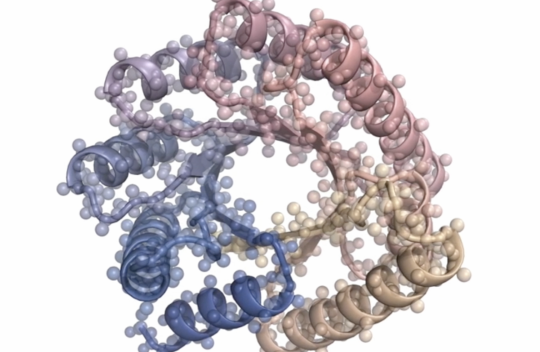
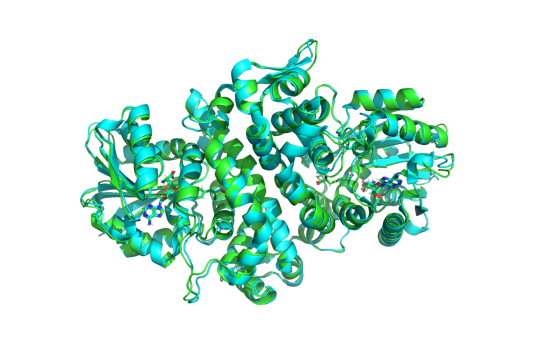
Developed by a team of researchers in the MIT Jameel Clinic for Machine Learning in Health, Boltz-1 is the first fully open-source model that achieves state-of-the-art performance at the level of AlphaFold3, the model from Google DeepMind that predicts the 3D structures of proteins and other biological molecules.
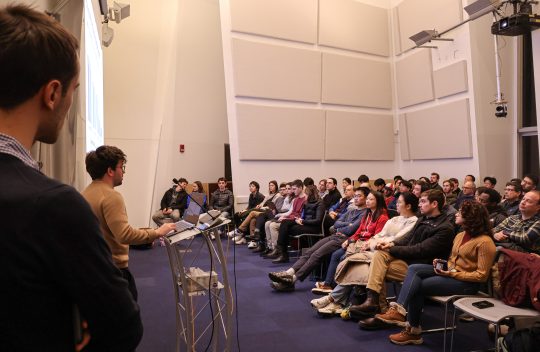
MIT graduate students Jeremy Wohlwend and Gabriele Corso were the lead developers of Boltz-1, along with MIT Jameel Clinic Research Affiliate Saro Passaro and MIT professors of electrical engineering and computer science Regina Barzilay and Tommi Jaakkola. Wohlwend and Corso presented the model at a Dec. 5 event at MIT’s Stata Center, where they said their ultimate goal is to foster global collaboration, accelerate discoveries, and provide a robust platform for advancing biomolecular modeling. Learn more
Explores algorithms that leverage the geometric and spatial properties of molecular structures, incorporating symmetry, invariance, and equivariance principles to enhance model performance and interpretability in molecular modeling. Learn more
Today, the U.S. Department of Health and Human Services (HHS) through the Advanced Research Projects Agency for Health (ARPA-H) announced funding for the Transforming Antibiotic R&D with Generative AI to stop Emerging Threats (TARGET) project, which will use AI to speed the discovery and development of new classes of antibiotics. This program is another action to support the United States’ longstanding commitment to combating antimicrobial resistance (AMR), from groundbreaking innovation to international collaboration. The U.S. is a global leader in the fight against AMR and has a demonstrated track record of progress in protecting people, animals, and the environment from the threat of AMR domestically and globally.
“Antibiotic resistance is a real and urgent threat affecting millions of people. We need to prevent infections and conserve the antibiotics we have. We also urgently need new drugs to treat these increasingly resistant infections. This project will use AI to speed this needed innovation and help ensure we have the medicines we need to keep people alive,” said Secretary Xavier Becerra. Learn more
When I first became a doctor, I cared for an older man whom I’ll call Ted. He was so sick with pneumonia that he was struggling to breathe. His primary-care physician had prescribed one antibiotic after another, but his symptoms had only worsened; by the time I saw him in the hospital, he had a high fever and was coughing up blood. His lungs seemed to be infected with methicillin-resistant Staphylococcus aureus (MRSA), a bacterium so hardy that few drugs can kill it. I placed an oxygen tube in his nostrils, and one of my colleagues inserted an I.V. into his arm. We decided to give him vancomycin, a last line of defense against otherwise untreatable infections.
Ted recovered with astonishing speed. When I stopped by the next morning, he smiled and removed the oxygen tube, letting it dangle near his neck like a pendant. Then he pointed to the I.V. pole near his bed, where a clear liquid was dripping from a bag and into his veins.
“Where did that stuff come from?” Ted asked.
“The pharmacy,” I said.
“No, I mean, where did it come from?”
At the time, I could barely pronounce the names of medications, let alone hold forth on their provenance. “I’ll have to get back to you,” I told Ted. He was discharged before I could. But, in the years that followed, I often thought about his question. Every day, I administer medicines whose origins are a mystery to me. I occasionally meet a patient for whom I have no effective treatment to offer, and Ted’s inquiry starts to seem existential. Where do drugs come from, and how can we get more of them? Learn more