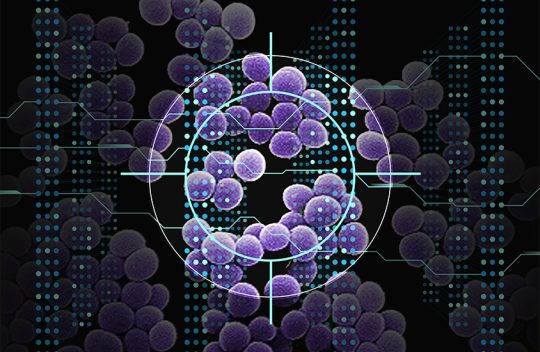
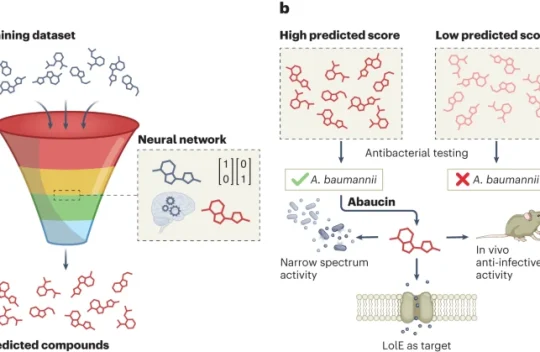
Using a type of artificial intelligence known as deep learning, MIT researchers have discovered a class of compounds that can kill a drug-resistant bacterium that causes more than 10,000 deaths in the United States every year. Learn more
Antibiotic resistance is among the biggest global threats to human health. It was directly responsible for an estimated 1.27 million deaths in 2019 and contributed to nearly five million more. The problem only got worse during the COVID pandemic. And no new classes of antibiotics have been developed for decades. Learn more
The MIT Jameel Clinic, the epicentre of artificial intelligence (AI) in healthcare at the Massachusetts Institute of Technology (MIT), hosted today its first conference in Saudi Arabia to advance the use of AI in healthcare. The 2023 edition of AI Cures • MENASA aims to explore the integration of AI into healthcare with a focus on the Middle East, North Africa, and South Asia (MENASA) region. Learn more
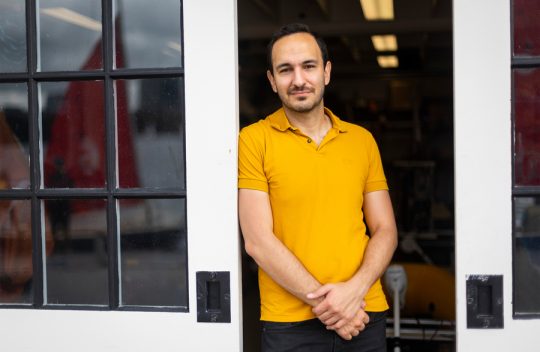
A Lebanese professor at the Massachusetts Institute of Technology who specialises in wireless technology and wireless sensing has become the second recipient of the Great Arab Minds Award.
Fadil Adib, associate professor at MIT, won the 2023 award in engineering and technology for his research and inventions that "have significantly expanded the possibilities of wireless sensing technology", the award announcement said. Learn more
On 30 November 2022, the technology company OpenAI released ChatGPT — a chatbot built to respond to prompts in a human-like manner. It has taken the scientific community and the public by storm, attracting one million users in the first 5 days alone; that number now totals more than 180 million. Seven researchers told Nature how it has changed their approach. Learn more
I’ll wager that the event of 2023 that will change our lives the most in coming years is not the sighting of a Chinese spy balloon, the failure of Silicon Valley Bank, the fall of Kevin McCarthy’s speakership or any of the other eruptions that transfixed us this year.
More likely, the event that’s judged most transformative will be some scientific or technological advance that only a handful of people know about right now — because that’s how things almost always go. The first time the word “transistor” appeared in print was in an article in The New York Times in 1948, on Page 46, following a report on two new radio shows, “Mr. Tutt” and “Our Miss Brooks.” I think we can agree that the transistor has had more impact on our daily lives in the 75 years since than either of those bits of entertainment. Learn more
Lung cancer kills more people in the US yearly than the next three deadliest cancers combined. It's notoriously hard to detect the early stages of the disease with X-rays and scans alone. However, MIT scientists have developed an AI learning model to predict a person's likelihood of developing lung cancer up to six years in advance via a low-dose CT scan. Learn more
Computational approaches are emerging as powerful tools for the discovery of antibiotics. A study now uses machine learning to discover abaucin, a potent antibiotic that targets the bacterial pathogen Acinetobacter baumannii. Learn more