Hartford HealthCare launches new center to use artificial intelligence in hospitals
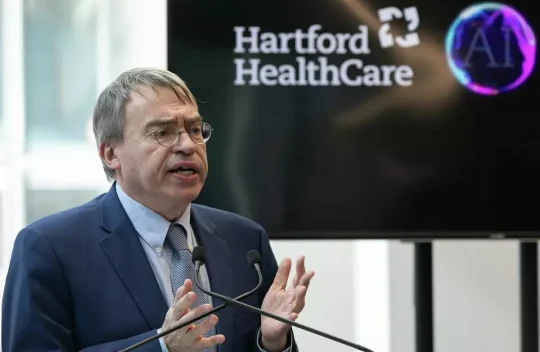
HARTFORD — Hartford HealthCare is launching a new center dedicated to using artificial intelligence in healthcare, which officials said is the first in New England and one of a few in the United States.The goal of using AI in a hospital system is to create more equitable and affordable healthcare, Jeffrey Flaks, president and chief executive officer of Hartford HealthCare, said at a press conference announcing the launch this week.
"Artificial intelligence is ubiquitous in healthcare," Flaks said. "It has the potential to impact all aspects of our operations, but our focus is to make healthcare more accessible, more affordable, to make it more equitable and to make it better."
Some of the research initiatives using AI include predicting COVID-19 spikes, how long someone might stay at the hospital, how a patient's condition might worsen, if a secondary stroke might happen and the outcomes of different surgeries. It can also be used in scheduling to make the hospital more efficient, officials said.
The Center for AI Innovation in Healthcare comes from a nearly decade-long, ongoing international collaboration between Hartford HealthCare, the Massachusetts Institute of Technology and the University of Oxford.
"To advance ourselves from being one of the earliest early adapters, to now being a co-developer, inventor and creator, and to be a pioneer in artificial intelligence, gives us the opportunity to truly impact how we deliver healthcare," Flaks said.
Through the collaborations, Hartford HealthCare Innovation developed Holistic Hospital Optimization, nicknamed H2O, which uses AI to help make hospital operations more efficient, including scheduling staff and operating rooms, as well as predicting how long a patient will stay, officials said.
The AI system follows a Holistic AI in Medicine framework, Dimitris Bertsimas, associate dean of analytics at MIT-Sloan, said at the press conference. It analyzes data hospitals collect, such as tabular data and images, which can then be applied "in a real-world environment in high-quality healthcare."
Flaks said that by minimizing administrative tasks, the medical staff can feel supported and have their attention be on patients. Learn more