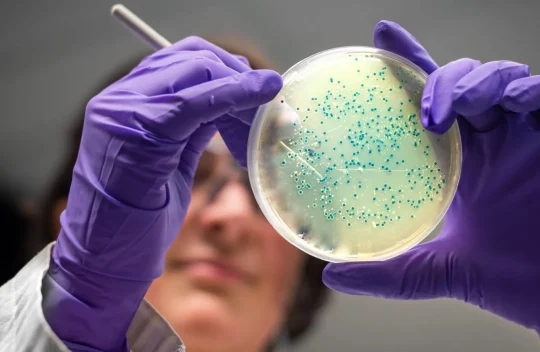
Artificial intelligence has invented two new potential antibiotics that could kill drug-resistant gonorrhoea and MRSA, researchers have revealed.
The drugs were designed atom-by-atom by the AI and killed the superbugs in laboratory and animal tests.
The two compounds still need years of refinement and clinical trials before they could be prescribed.
But the Massachusetts Institute of Technology (MIT) team behind it say AI could start a "second golden age" in antibiotic discovery. Learn more
A team at Massachusetts Institute of Technology (MIT) used generative AI algorithms to design more than 36 million possible compounds.
They also seemed to work in a new way - by disrupting bacterial cell membranes.
Antibiotics kill bacteria, but some infections have become resistant to drugs.
It is estimated that drug-resistant bacterial infections cause nearly five million deaths per year worldwide.
Two compounds were found to be effective against gonorrhoea and MRSA infections - namely NG1 and DN1, respectively. Learn more
With help from artificial intelligence, MIT researchers have designed novel antibiotics that can combat two hard-to-treat infections: drug-resistant Neisseria gonorrhoeae and multi-drug-resistant Staphylococcus aureus (MRSA).
Using generative AI algorithms, the research team designed more than 36 million possible compounds and computationally screened them for antimicrobial properties. The top candidates they discovered are structurally distinct from any existing antibiotics, and they appear to work by novel mechanisms that disrupt bacterial cell membranes.
This approach allowed the researchers to generate and evaluate theoretical compounds that have never been seen before — a strategy that they now hope to apply to identify and design compounds with activity against other species of bacteria.
“We’re excited about the new possibilities that this project opens up for antibiotics development. Our work shows the power of AI from a drug design standpoint, and enables us to exploit much larger chemical spaces that were previously inaccessible,” says James Collins, the Termeer Professor of Medical Engineering and Science in MIT’s Institute for Medical Engineering and Science (IMES) and Department of Biological Engineering. Learn more
What challenges does health care still face when implementing AI?
The excitement of ambient scribes and AI chatbots has started to wear off, and health care is running out of quick wins as it looks to construct this "new world."
While AI promises efficiency, health systems will have to put in significant time to unlock its full benefits.
Beyond note-taking tools, there are "very little success stories" of clinically implemented AI, said Dr. Regina Barzilay, distinguished professor of AI & Health in the Department of Computer Science at MIT's School of Electrical Engineering and Computer Science and the AI Faculty Lead at MIT's Jameel Clinic.
She told Newsweek that there are abundant stories of new AI algorithms that show promising results but few that have actually proven themselves beyond mere promise. Learn more
Most computational research in organ allocation is focused on the initial stages, when waitlisted patients are being prioritized for organ transplants. In a new paper presented at ACM Conference on Fairness, Accountability, and Transparency (FAccT) in Athens, Greece, researchers from MIT and Massachusetts General Hospital focused on the final, less-studied stage: organ offer acceptance, when an offer is made and the physician at the transplant center decides on behalf of the patient whether to accept or reject the offered organ.
Learn more
In 2020, researchers at the Collins Lab at MIT made a landmark discovery when they used AI to identify a new class of antibiotics. Phare Bio was born from that breakthrough, and has since leveraged AI to uncover two additional novel antibiotic classes.
The company's model prioritizes the superbugs identified as the most dangerous by the CDC and the WHO, and predicts drug efficacy, toxicity and pharmacokinetics with high accuracy. Phare Bio has also developed AIBiotics, a generative AI platform that designs new antibiotics.
Ultimately, the company aims to improve the efficiency of antibiotic research and development, according to Dr. Akhila Kosaraju, its president and CEO.
How does it measure that? Ultimately, by "taking better and fewer shots on goal," Kosaraju told Newsweek. It often costs between $1.3 and $1.5 billion to get a single drug over the finish line for FDA approval.
"Those numbers are so high [because they] encompass all of the failures along the way to get to that one exceptional drug," Kosaraju said. "If we can reduce the number of shots on goal substantially, we can half or quarter the cost and time to get these drugs into clinical trials, and then ultimately to be FDA-approved."
To see the full list of AI Impact winners, visit the official page for Newsweek's AI Impact Awards. Learn more
When Regina Barzilay was diagnosed with breast cancer in 2014, it upended her life and shifted the direction of her research. Already an accomplished computer scientist specializing in natural language processing, her experience as a patient shed light on the possibility of new applications for machine learning and revealed a stark disconnect between technology’s promise and its implementation in health care. “It was upsetting to see that all these great technologies are not translated into patient care,” she recalls. “I wanted to change it.” After going through her own treatment, Barzilay’s work took on an urgent new focus: could the very technologies she used in her research predict who might be at risk for breast cancer? Learn more