

C&EN’s Talented Twelve: Loza Tadesse
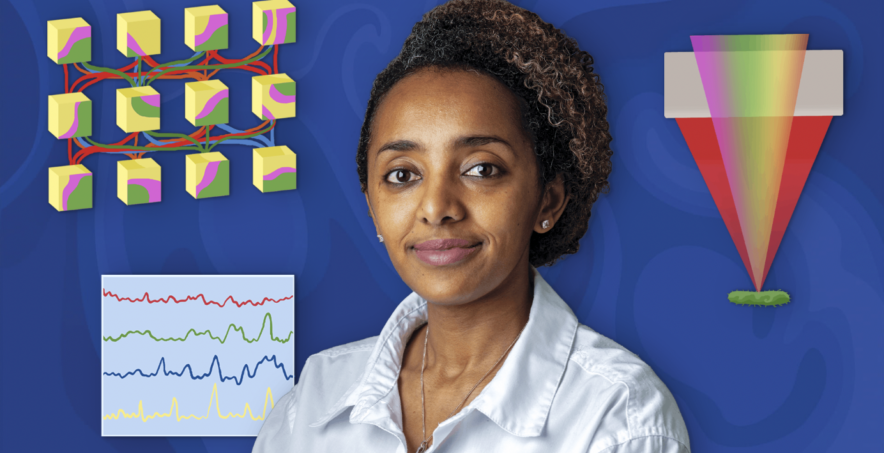
Harnessing AI and light for next-generation optical tools
When Loza Tadesse learned about light-matter interactions in her first physical chemistry class, she was reminded of God. “I am a woman of faith,” she explains. In her eyes, light has always been connected to a higher power. Learning about the duality of light—it exists as both a wave and a particle—and how it interacts with the building blocks of the universe, atoms and their electrons, “was deeply meaningful to me and scientifically very exciting,” she says.
Today, as a mechanical engineering professor at the Massachusetts Institute of Technology, Tadesse harnesses light-matter interactions to create low-cost, ultrasensitive diagnostic tools. “We’re building platform technologies agnostic to what is being measured,” she says.
Tadesse’s motivation comes from her formative years as a medical student in Ethiopia. She started clinical rotations straight out of high school, when she was 17. It was the real world of medicine, full of illness and death, a “grow-up-quickly type of situation,” she says.
Roaming the hospital halls, Tadesse realized that patient care wasn’t hindered by lack of medical knowledge—the doctors were brilliant—but by the lack of resources. She decided to pivot away from clinical practice. Unsure of her path, Tadesse left home in her fourth year of medical school and set out for the US.
In her first year at Minnesota State University Moorhead, Tadesse discovered her calling: she would engineer medical diagnostic tools. After graduating, she was accepted into a bioengineering PhD program at Stanford University. There she helped develop a Raman spectroscopy tool to rapidly diagnose bacterial infections.
She went on to complete postdoctoral work at the University of California, Berkeley, where she learned how to use artificial intelligence to design instruments capable of overcoming the limitations of traditional optical systems. “Now my lab works at the intersection of optical techniques and machine learning approaches for the betterment of human and planetary health,” Tadesse says.
Her new generative AI platform, SpectroGen, encapsulates that intersection. She developed it with Yanmin Zhu, her postdoc at the time, after pondering the challenge of characterizing new materials. Scientists must collect multiple high-resolution spectra to fully understand the characteristics of a material, Tadesse explains. But not every lab has access to the best instrumentation for the job.
In the age of AI, was there a way to go hardware-free and generate physical measurements virtually?
It seemed possible: the physical interaction between light and matter is innately coded in spectra, Tadesse says. Because of the way light vibrates molecules, spectral signals typically widen into distinct curve shapes. AI readily recognizes the mathematical pattern coded into those curves.
Tadesse and Zhu used this pattern recognition to design SpectroGen, which takes spectra collected by one type of instrument to generate virtual spectra from other types. To test the AI model, they fed it experimental infrared spectra from a mineral database and asked it to generate virtual X-ray diffraction (XRD) spectra. “It had 99% correlation with the experimental output version of the XRDs,” Tadesse says.
“I really like the idea,” says Chibueze Amanchukwu, a molecular engineer at the University of Chicago who has known Tadesse since she was a graduate student. Materials scientists could save resources, he says, “if you were able to use machine learning methods to generate that spectra with high fidelity.”
Along with developing AI, Tadesse is developing physical devices. She’s particularly excited about disease diagnostics like an ongoing project to make a breath-based platform that can quickly identify bacterial pneumonia infections. Speeding up diagnoses helps doctors know when to prescribe antibiotics.
Having a fast, noninvasive way of being able to detect what’s causing a pneumonia infection would be “huge,” says Cullen Buie, a colleague of Tadesse’s at MIT who has known her since her days at Stanford. Tadesse is very good at identifying interesting physical phenomena and harnessing them for practical applications, he says. It may take decades for the new technologies to have a tangible impact, but Buie sees their potential.
Tadesse’s academic labors may take time to bear fruit, but her students already recognize her as an exceptional mentor. In 2025, she was selected for the MIT Committed to Caring award, a student-driven initiative to recognize impactful mentors. Tadesse also connects African students with US researchers through SciFro, a nonprofit she cofounded as a graduate student.
“Everybody has a light in them,” she says. “My goal as a mentor is to make it shine as bright as possible.”
–
