

Jameel Clinic Principal Investigator Loza Tadesse Named to MIT Technology Review’s 2026 Innovators Under 35
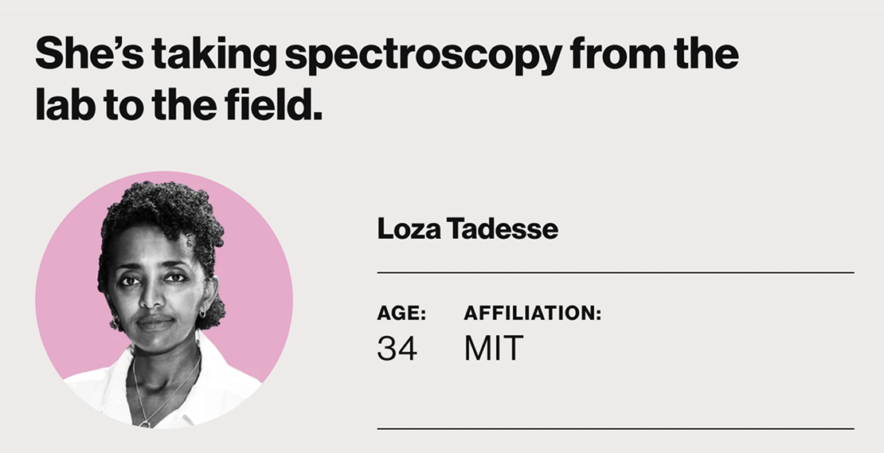
CAMBRIDGE, MA — Loza Tadesse, d’Arbeloff Career Development Assistant Professor of Mechanical Engineering at MIT and a Principal Investigator at the MIT Abdul Latif Jameel Clinic for Machine Learning in Health (MIT Jameel Clinic), has been named to MIT Technology Review’s 2026 list of Innovators Under 35. The annual list recognizes engineers, researchers, and entrepreneurs under age 35 who are tackling important problems in creative ways and have already delivered results with real-world impact.
Tadesse was honored in the biotechnology category, which spotlights innovators using tools like AI and gene editing to advance medicine.
Her path to this work began during her medical training in Ethiopia, where Tadesse observed firsthand how limited access to diagnostic tools, like MRI machines and basic lab equipment, creates constraints for the care doctors are able to provide. And that gap isn’t unique to low-resource settings: even a routine blood test often means days of waiting for lab results before treatment can begin.
Now, Tadesse is building tools that can analyze the chemical makeup of a wide range of substances far faster than conventional methods allow. Her lab developed a compact sensor that can diagnose pneumonia from a simple breath test, and that can be adapted to detect other biological molecules, industrial chemicals, or other materials of interest.
But Tadesse’s core expertise is in spectroscopy — the study of how materials absorb, reflect, and scatter light — which can be used to analyze anything from drug composition to the makeup of distant galaxies. Traditionally, fully characterizing a substance requires multiple types of spectroscopy measurements, such as Raman scattering, x-ray diffraction, and infrared absorption, each requiring different equipment.
Tadesse’s lab is investigating how generative AI could change that equation with an approach she calls “virtual spectroscopy.” By building AI models grounded in physics, her team has shown that a single measurement can be used to algorithmically generate the others. Their SpectroGen tool, described in a recent paper in Matter, produced results that closely matched nearly 700 conventional measurements of mineral samples.
The implications extend well beyond convenience: the approach challenges the assumption that accurate material identification requires an expensive, fully equipped lab. “I could carry a simple instrument…that brings this whole big lab with me,” she says.
Tadesse’s vision extends beyond medicine. She envisions a world where anyone — whether in medicine, manufacturing, agriculture, or environmental monitoring — can obtain “high-quality information about whatever they’re trying to investigate,” whenever and where it’s needed.
About the Jameel Clinic
The MIT Abdul Latif Jameel Clinic for Machine Learning in Health (MIT Jameel Clinic) was founded on the recognition that an alarming gap exists between what AI is currently capable of and the reality of how AI is being used in health today, costing countless lives and needless suffering. To that end, the Jameel Clinic pioneers translational research in clinical AI and AI-driven drug discovery that can be applied across a broad spectrum of real-world scenarios in health, regardless of geography, socioeconomic status, and access to care. Its efforts are singularly devoted to addressing the unmet needs of patients with urgency, precision, and transparency. As AI makes rapid progress, the Jameel Clinic’s intent is to both build and be the bridge between a rapidly accelerating technology and the world of medicine
