

Jameel Clinic Research Affiliate Gabriele Corso Named to MIT Technology Review’s 2026 Innovators Under 35
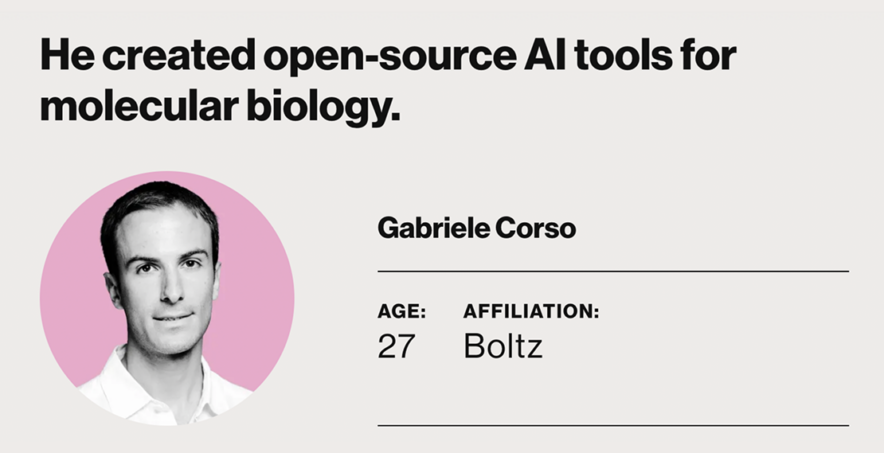
CAMBRIDGE, MA — Gabriele Corso, a research affiliate with the MIT Abdul Latif Jameel Clinic for Machine Learning in Health (MIT Jameel Clinic) and co-founder of Boltz, has been named to the MIT Technology Review’s 2026 list of Innovators Under 35. The annual list recognizes engineers, researchers, and entrepreneurs under the age of 35 who are tackling important problems in creative ways and have already delivered results with real-world impact.
Corso, now the CEO of Boltz, was honored in the biotechnology category, which spotlights innovators using tools like AI and gene editing to advance medicine.
Corso’s recognition traces back to a pivotal moment in AI-driven biology. In 2024, Google DeepMind unveiled AlphaFold3, a model for predicting the structure and behavior of biologically significant molecules that the company said outperformed traditional physics-based methods. But the model was released to academic researchers only after sustained pressure from the scientific community, and came with usage restrictions that frustrated many in the field, including Corso. But these restrictions kicked off a global race to see who would be the first to fully reproduce an open-source version of AlphaFold3.
At the time, Corso, then a PhD student co-advised by Jameel Clinic AI faculty lead Regina Barzilay and Jameel Clinic principal investigator Tommi Jaakkola, began co-developing Boltz-1 with then-PhD student and lab mate Jeremy Wohlwend (co-founder and CTO of Boltz) and then-Jameel Clinic research scientist Saro Passaro (co-founder of Boltz). Rather than follow AlphaFold3’s more restricted release model, the team published Boltz-1 as a fully open-source project: code, model weights, training data, and benchmarks, all freely available for anyone to use or modify.
That was only the beginning. Corso’s team went on to release Boltz-2, a successor model, and BoltzGen (with lab mate Hannes Stärk), a generative AI tool for designing proteins that bind to specific molecular targets, released under the same open licensing terms. In January, Corso, Wohlwend, and Passaro launched Boltz as a public benefit corporation to continue developing the models and to build software and services around them.
According to Corso, models built on this body of work are now in use at all twenty of the world’s largest pharmaceutical companies, along with thousands of biotech firms and hundreds of thousands of scientists worldwide.
Corso has framed the project’s open approach as a deliberate stance on how AI tools for science should be shared: “Everything we do will be accessible,” he says. “Some will be open source; some will be available by API [application programming interface]. We will continue to make them available as widely as possible.”
About the Jameel Clinic
The MIT Abdul Latif Jameel Clinic for Machine Learning in Health (MIT Jameel Clinic) was founded on the recognition that an alarming gap exists between what AI is currently capable of and the reality of how AI is being used in health today, costing countless lives and needless suffering. To that end, the Jameel Clinic pioneers translational research in clinical AI and AI-driven drug discovery that can be applied across a broad spectrum of real-world scenarios in health, regardless of geography, socioeconomic status, and access to care. Its efforts are singularly devoted to addressing the unmet needs of patients with urgency, precision, and transparency. As AI makes rapid progress, the Jameel Clinic’s intent is to both build and be the bridge between a rapidly accelerating technology and the world of medicine.
