

A New Standard for Breast Cancer Screening: How AI Is Changing the Guidelines
By Ed Levy, Public Health Liaison
It is unequivocally true that screening for breast cancer with mammography has saved countless lives. But underneath this truth are conflicts of evidence and opinion about the right time to start screening; the frequency of screening; the role of additional screening for the many women with dense breasts; and the continued disparity in outcomes for Black women, who often present at younger ages with more advanced and aggressive cancers.
Substantial efforts have been made to work through these issues with individualized risk assessment. Most notable have been history-based models such as Tyrer-Cuzick, Gail, and density based models. These well-funded efforts, driven by scientific energy and thought, have been challenged to show meaningful effectiveness in preventing disease and resolving outcome disparities.
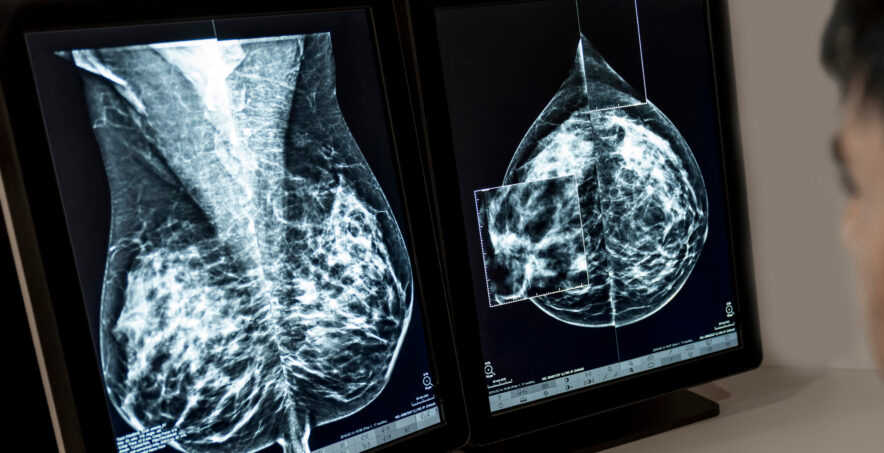
This month has transformed the landscape for breast screening, with the official guideline from the National Comprehensive Cancer Network (NCCN) recommending advanced follow-up with MRI for women with high risk (greater than or equal to 1.67 percent in 5 years) based on AI assessments of mammograms. Across two million mammograms in countries with highly diverse populations, the Mirai algorithm, developed by Jameel Clinic research affiliate Adam Yala (then a graduate student at MIT) and Jameel Clinic AI faculty lead Regina Barzilay, is the core technology that brought about this change.
Mirai cuts through the Gordian knots of debate and resource allocation to identify which women are at high risk and require monitoring, and which women can be reassured that they have lower risk. Family history only accounts for 15 percent of breast cancers and breast cancer is affecting younger women at higher rates. In the U.S., this is a huge step towards women getting this information without exorbitant private expenses for MRIs. In more resource-constrained countries, this can be used to triage access to limited resources such as 3D mammography and more frequent screenings.
As important as the new NCCN guideline is for preventing cancer in women, this is also a huge moment for AI in healthcare. Most AI applications are more niche, such as detecting sepsis in hospitalized patients or diagnosing diabetic retinopathy. Not only does Mirai apply to half of the population, but it also addresses the most common cancer in that population.
Breast cancer has a large presence in the health and consciousness of a society, as it affects women in the prime of their lives — women who often have active careers, dependent children, and elders who need support. Much of the commentary around AI has been overwrought, with AI portrayed both as a Genie fulfilling every wish and a Demon promising destruction. As a scientifically validated model serving as the basis for a new screening guideline, Mirai has successfully cut through the noise and is now on its way to support the 80 percent of women in this country who are screened.
