If a picture is worth a thousand words, then in artificial intelligence, a picture can be worth millions of data points. AI’s superior ability to analyze images and large volume of imaging-based AI models is why many consider radiology to be among the medical fields most impacted by the rise of AI.
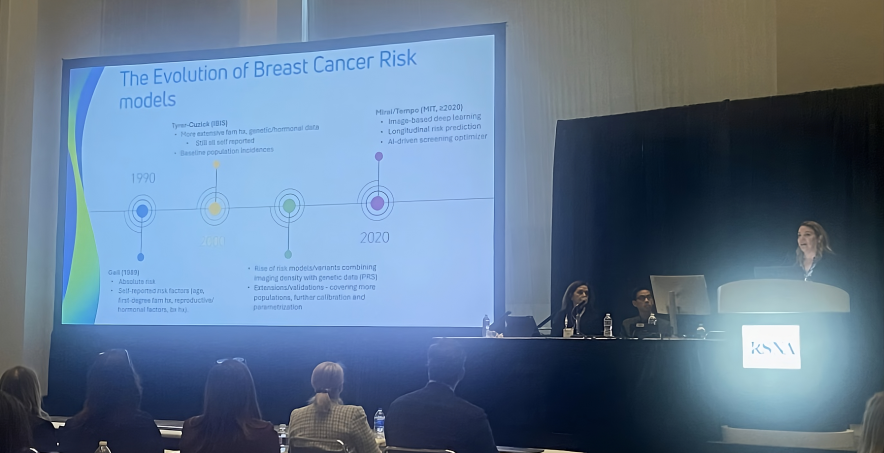
This was no less true at this year’s RSNA Annual Meeting (Nov. 30 – Dec. 4), the world’s largest radiology conference and one of the largest medical meetings overall, where Mirai was prominently featured.
Over the years, Mirai, a deep learning model for 5-year breast cancer risk prediction that was released in 2019, has been the subject of a number of validation studies conducted by clinicians who have been interested in the model’s potential to personalize breast cancer screening.
At this year’s RSNA meeting, validation research on Mirai was shared across nine different sessions in 13 presentations given by clinicians from hospitals across the U.S., marking shift the technology’s adoption that will hopefully only continue to grow.
Below are the 13 abstracts conducting additional validation research on Mirai in different contexts:
S3A-SPBR-4 TRANSFORMER-BASED MULTIMODAL AI RISK MODEL FOR LONG-TERM BREAST CANCER RISK ESTIMATION: PERFORMANCE AND EXTERNAL VALIDATION
S3B-SPBR-7 LONGITUDINAL CHANGE OF MAMMOGRAPHIC AI RISK SCORES OVER REPEATED SCREENING EXAMS
S5-SSBR02-3 ROBUSTNESS OF AN AI SHORT-TERM BREAST CANCER RISK MODEL IN A CLINICAL SETTING WITH DIVERSE MAMMOGRAPHY MODALITIES: PRELIMINARY RESULTS
S5-SSBR02-6 MULTIMODAL AI MODEL BREAST CANCER RISK PREDICTION: PERFORMANCE IN AN INCREASED GENETIC RISK COHORT
M2-SPBR-3 IMPROVED 3-YEAR BREAST CANCER RISK PREDICTION BY COMBINING ANATOMICAL NOISE POWER EXPONENT AND MIRAI: A LARGE CLINICAL STUDY
M7-SSBR03-1 DO DEEP LEARNING BREAST CANCER RISK SCORES CHANGE MEANINGFULLY OVER TIME? A LONGITUDINAL ANALYSIS
M7-SSBR03-3 MAMMOGRAPHY AI RISK SCORE PERFORMANCE STRATIFIED ACROSS BI-RADS BREAST DENSITY AMONG A COHORT OF 183,441 WOMEN WITH A NEGATIVE SCREENING MAMMOGRAM OVER 15 YEARS
M7-SSBR03-4 IMAGE-ONLY DEEP LEARNING RISK MODEL VS BREAST DENSITY TO PREDICT FALSE NEGATIVE EXAMINATIONS
M7-SSBR03-5 IMPACT OF MAMMOGRAPHIC POSITIONING AND BREAST DENSITY ON AI-BASED SHORT-TERM BREAST CANCER RISK PREDICTION: PRELIMINARY RESULTS
T3-SSBR05-5 PROSPECTIVE FEASIBILITY STUDY OF MIRAI-EXPEDITED EVALUATION FOR HIGH-RISK SCREENING MAMMOGRAMS
W5A-SPBR-6 IDENTIFYING WOMEN AT RISK FOR ADVANCED-STAGE BREAST CANCER USING AN IMAGE-ONLY DEEP LEARNING RISK MODEL
W5A-SPPH-8 ANATOMICAL NOISE POWER EXPONENT AS AN IMAGE-BASED BIOMARKER OF BREAST CANCER RISK: IMPROVING AI MODEL PERFORMANCE – A PILOT STUDY
R2-SPBR-1 EXTERNAL VALIDATION OF BREAST CANCER RISK ASSESSMENT MODEL MIRAI ON DIVERSE SCREENING COHORT