

The University of Chicago Announces 2026 Recipients of the Pritzker Prize for AI in Science Research Excellence
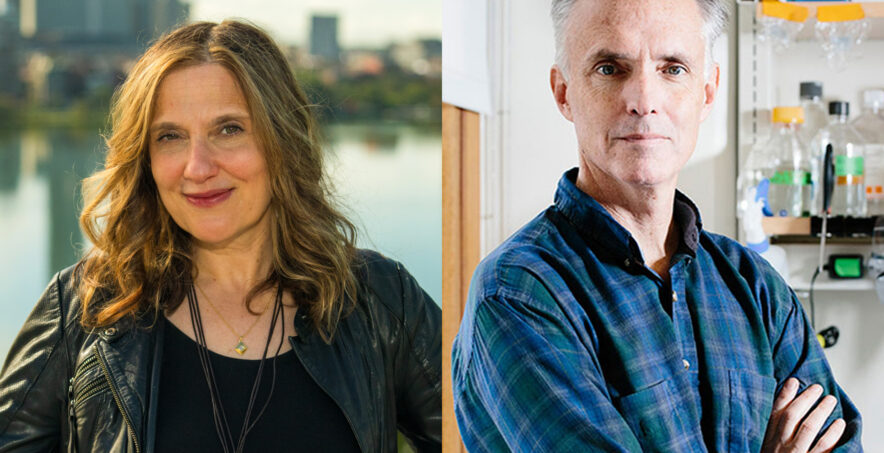
The University of Chicago has awarded Kristin Persson (University of California, Berkeley; Dept. of Materials Science and Engineering) and the team of James J. Collins (MIT; Dept. of Biomedical Engineering) and Regina Barzilay (MIT; Dept. of Electrical Engineering and Computer Science) as the 2026 recipients of the Pritzker Prize for AI in Science Research Excellence. Presented at the third University of Chicago and Caltech Conference on AI+Science, the prize recognizes outstanding academic contributions that jointly advance artificial intelligence and the natural sciences or engineering.
Established in 2024, the prize recognizes academic scientists and research teams whose work jointly advances artificial intelligence and the natural sciences or engineering. Each award carries a prize of $50,000.
Prize Selection Committee Member Eric Horvitz (Chief Scientific Officer, Microsoft) acknowledged the role the Prize has in advancing the larger field. Eric said, “The Prize recognizes exceptional work that harnesses AI to advance discovery across science and engineering. It’s been a privilege to serve on the selection committee, review inspiring nominations, and honor scientists whose passion and creativity are expanding the frontiers of scientific understanding.“

Kristin Persson (University of California, Berkeley) was recognized for pioneering data-driven materials design through first-principles computational methods and machine learning, and for founding and leading The Materials Project as a transformative global open-science resource. Persson has more than 350 peer-reviewed publications and over 82,000 citations. For her AI in science research, Kristin noted that “AI is not simply making an existing calculation fast. It is allowing us to ask scientific questions that were previously computationally inaccessible.”
In 2011, Persson founded the Materials Project as an open-access platform for computed materials data, analysis, and machine learning. Today it is the world’s most widely used materials data resource, serving more than 800,000 registered users and delivering terabytes of data globally each day, with approximately 3,000 new researchers joining every week.
For the first time in the Prize’s history, a team was awarded the Pritzker Prize. Regina Barzilay (MIT) and James J. Collins (MIT) were recognized for their pioneering collaboration applying deep learning to antibiotic discovery and drug design, one of the most consequential demonstrations of AI’s potential to address a global health crisis.
Together, Barzilay and Collins have used deep learning to discover and design structurally novel antibiotic compounds effective against some of the world’s most dangerous drug-resistant pathogens. Their Antibiotics-AI Project at MIT, in partnership with nonprofit Phare Bio, aims to develop seven new classes of antibiotics targeting seven of the world’s deadliest bacterial pathogens, a potential turning point in addressing antimicrobial resistance, which is projected to cause 10 million deaths annually by 2050.

James noted the possibilities AI has opened for antibiotic research. He said, “AI has significantly expanded the realm of possibility in life sciences. In the case of antibiotics, it’s allowed us to search for entirely new classes of compounds, understand how they work much faster, and even design new antibiotics from scratch.”
Prize chair Rebecca Willett, Worah Family Professor of Statistics and Computer Science in the Wallman Society of Fellows said “AI and science are reshaping each other. That only happens when researchers look beyond surface-level integration and understand both fields well enough to push the boundaries of each.” Together, these award-winning researchers’ bodies of work advance their fields, AI in scientific research, and society, which is what this Prize exemplifies.
